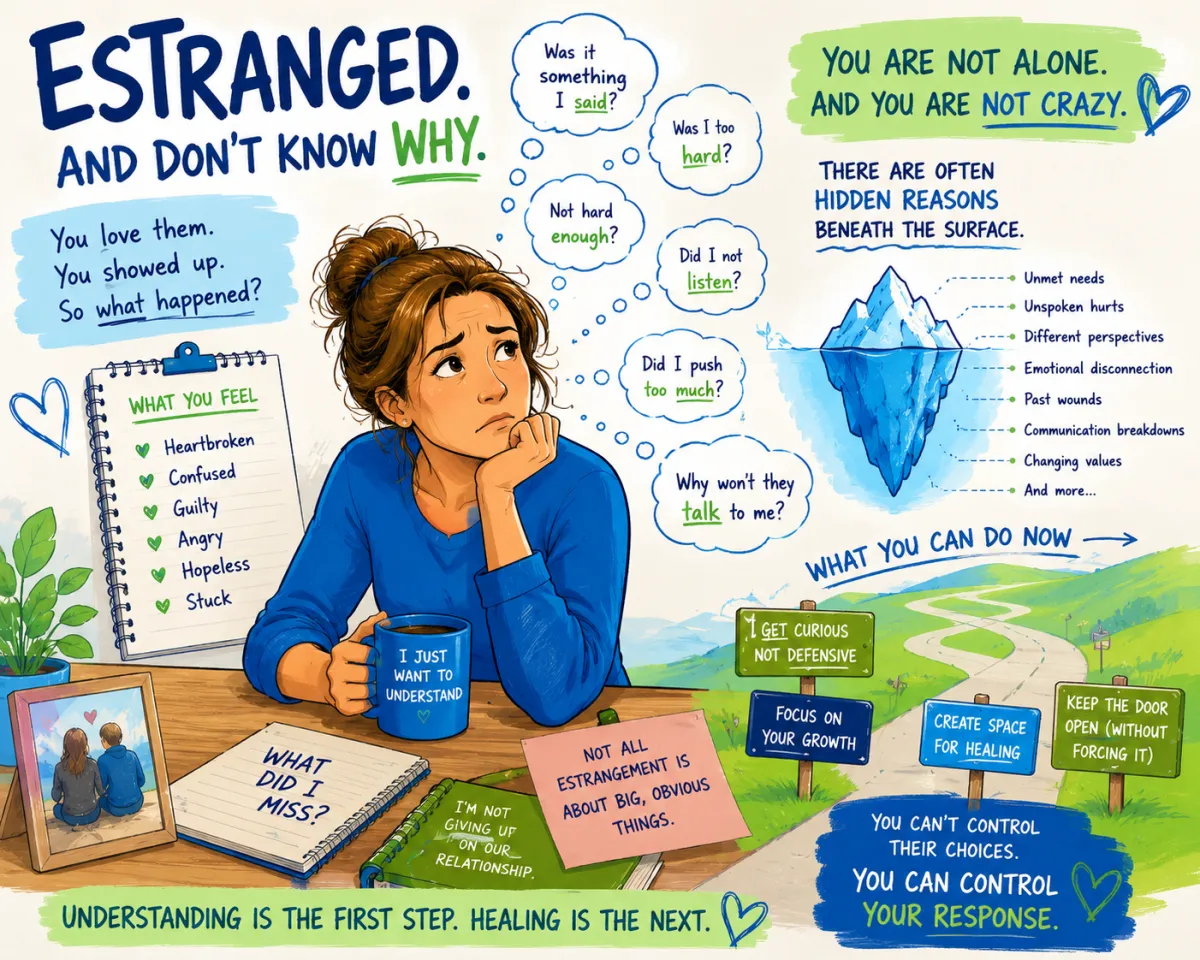
Why Reconnecting With Your Estranged Child Keeps Failing
You have reached out. More than once. Maybe many times.
A letter. A text. A call that went to voicemail. A message through another family member. A birthday card that was never acknowledged. You have tried different approaches, different tones, different timing. Some of it was careful and measured. Some of it came out with more emotion than you intended.
And the door stays closed.
So you go back through it again. You look at what you said, how you said it, whether the timing was wrong. You wonder if you should try again or give it more time. You wonder if there is a right combination of words that would finally land differently.
Here is what is worth looking at honestly.
It is probably not the words. It is what is underneath them.
What Your Child Is Actually Receiving
Every time you reach out, your child receives more than the message you intended to send.
They receive the entire framework the message is built on. The assumptions underneath it. The construct of what this relationship is supposed to be, what they owe you, what a good child looks like, what reconciliation should mean and who should initiate it.
You may not be saying any of that explicitly. You do not have to. Your child has been reading that framework their entire life. They know it fluently. They can hear it in a single sentence, sometimes in a single word choice.
When a parent reaches out and the subtext is still I did everything right and you are not seeing that clearly — the child hears it. When the outreach is framed around what the parent needs — to be forgiven, to be understood, to have the relationship restored on familiar terms — the child feels it. When the message carries the assumption that the parent is the authority on what happened and what should happen next, the door does not open.
Not because the child is cruel. Because they have heard this before. Many times. In many forms. And it has always been the same thing underneath.
The Three Moves That Keep the Door Closed
The first is suggesting therapy — for the child, or for both of you together. The intention is usually genuine. The impact is almost always the opposite of what you want. It signals to your child that you see them as the problem. That their feelings and their distance are symptoms of something wrong with them that needs to be fixed. The child who has been trying to be seen as a capable adult does not experience that as an olive branch.
The second is the inverse — your child has suggested therapy, perhaps many times, and you have deflected or refused. Every time that happened, your child received a message: I am not willing to examine myself. I am not willing to look at my part in this. The history of those moments travels in every outreach you send now. Your child remembers.
The third is the one that overrides both of those. You are still reaching out as a parent to a child. Not as one adult to another. The authority position — the assumption that you have the standing to define what this relationship should be, how it should be repaired, what the child should be willing to receive from you — is still present. Your child is an adult. They are individuating. They are building a life and an identity that is theirs. The parent who approaches them as though they still hold authority over that process will keep finding the door closed, regardless of how warmly the message is worded.
What Is Actually Driving the Distance
Your adult child has been telling you something for a long time.
You do not hear me. You do not see me. You are not listening.
Not as an accusation exactly. As a description of their experience inside the relationship. Every time they said it and the conversation moved back to your perspective, your intentions, your version of events — the gap widened. Not because you are a bad parent. Because the dynamic confirmed exactly what they were describing.
The lens problem runs deep. When you look at your child, you are looking through a lens built from your generation, your culture, your religion, your understanding of what family means and what it requires. That lens is not wrong. It is genuinely yours. But it is not the only lens in the room.
Your child has a different lens. Built from their experience of growing up inside your household. From what they needed and did not receive. From who they have become as an adult and what they now understand about themselves. From the distance that finally gave them enough room to see things clearly.
When you reach out and ask them to see the situation through your lens — to recognize your good intentions, to appreciate what you provided, to understand why you did what you did — you are asking them to put their lens down and pick yours up.
They have done that their whole life. They are not willing to do it anymore.
What Actually Opens the Door
The parents who successfully reconnect with their estranged children are not the ones who made the most compelling case. They are not the ones who found the perfect words or the right timing or the most generous gesture.
They are the ones who got quiet.
Who stopped trying to be right about what happened. Who stopped reaching out with an agenda, even a loving one. Who put the constructs down — the family allegiance, the generational roles, the ideas of what a child owes a parent — and looked at the actual human being on the other side.
The shift is not strategic. It is genuine. And your child will know the difference.
When that shift has happened — when you have done enough work on yourself that you can honestly say you see things you did not see before — the outreach changes completely. Not in tone. In substance.
It sounds something like this: I have been doing some work. I see some things differently than I did before. I am not asking for anything. If you are ever open to a different kind of conversation than we have had in the past, I would like to try. There is no pressure and no timeline.
That is it. No case made. No history relitigated. No request for forgiveness or acknowledgment or return to the way things were. Just an open door with no conditions attached.
And then you wait. Without following up to ask if they received it. Without sending another message two weeks later to make sure they know you meant it. The door is open. You leave it open. That is the whole move.
What Happens When They Walk Through
When your child finally responds — and in my experience working with parents in this situation, the open door without pressure usually does eventually get a response — the conversation that follows will determine everything.
Most parents get this wrong too. Not because they are not trying. Because the moment the child shows up, the old dynamic tries to reassert itself. The parent has things they want to say. Context they want to provide. Their side of the story that they have been waiting to share.
The instinct is completely understandable. It is also the thing that closes the door again.
The parents who rebuild something real with their adult children do the hardest thing available to them in that conversation. They shut up and listen. Not politely waiting for their turn to speak. Actually listening. Receiving what their child is saying without measuring it against their own memory of events. Without correcting the record. Without explaining why they did what they did.
They say: thank you for sharing that. And they mean it.
When a child who has spent years feeling unheard finally feels heard — really heard, without being redirected or defended against — something shifts. The guard comes down. Not all at once. But enough. Enough to consider another conversation. Enough to let a little curiosity in on both sides.
That is how it starts. Not with a grand reconciliation. With one conversation where someone finally felt seen.
Your Lens Is Not the Only One in the Room
This is the thing that changes everything when a parent finally lets it land.
The failed outreach attempts are not evidence that your child is unreachable. They are evidence that the same dynamic that drove the estrangement is still present in every message you send.
When you can put your lens down — the constructs, the roles, the righteousness, the ideas of how this is supposed to go — and look at your child as a separate human being with their own valid experience of what happened between you, the relationship becomes possible again.
Not the relationship you had. Something new. Something built between two adults who actually see each other.
That is worth more than being right about the past.
If you are ready to understand what is driving this dynamic in your own system — not to assign blame but to actually see it clearly — the 7-Day Capacity Reset inside The YOUniverse is where that work starts. You cannot offer your child a genuinely different conversation until you have had a genuinely different look at yourself. That is where we begin.