Why Do I Feel Broken as a Parent?
You saw it coming.
That is the part that makes it worse.
You felt the pressure building. You knew you were close to the edge. And then your kid came running in, grabbed your arm, started talking at full volume about something that needed your attention right now...and you snapped.
Not a little. The kind of snap you hear yourself doing and cannot believe is coming out of your mouth.
And then you watched their face change.
That is the moment that stays with you. Not the snap itself. The impact. The way their expression shifted. The thing you saw in their eyes that told you something just landed that you cannot take back.
You have done enough work on yourself to know exactly what you just did. Which means the shame that follows is not vague. It is precise. You know the wound you just created because you have spent years understanding your own.
That knowledge does not make it better. It makes it worse.
You Are Not a Bad Parent. You Are a Full One.
Here is what was actually happening before you walked through that door.
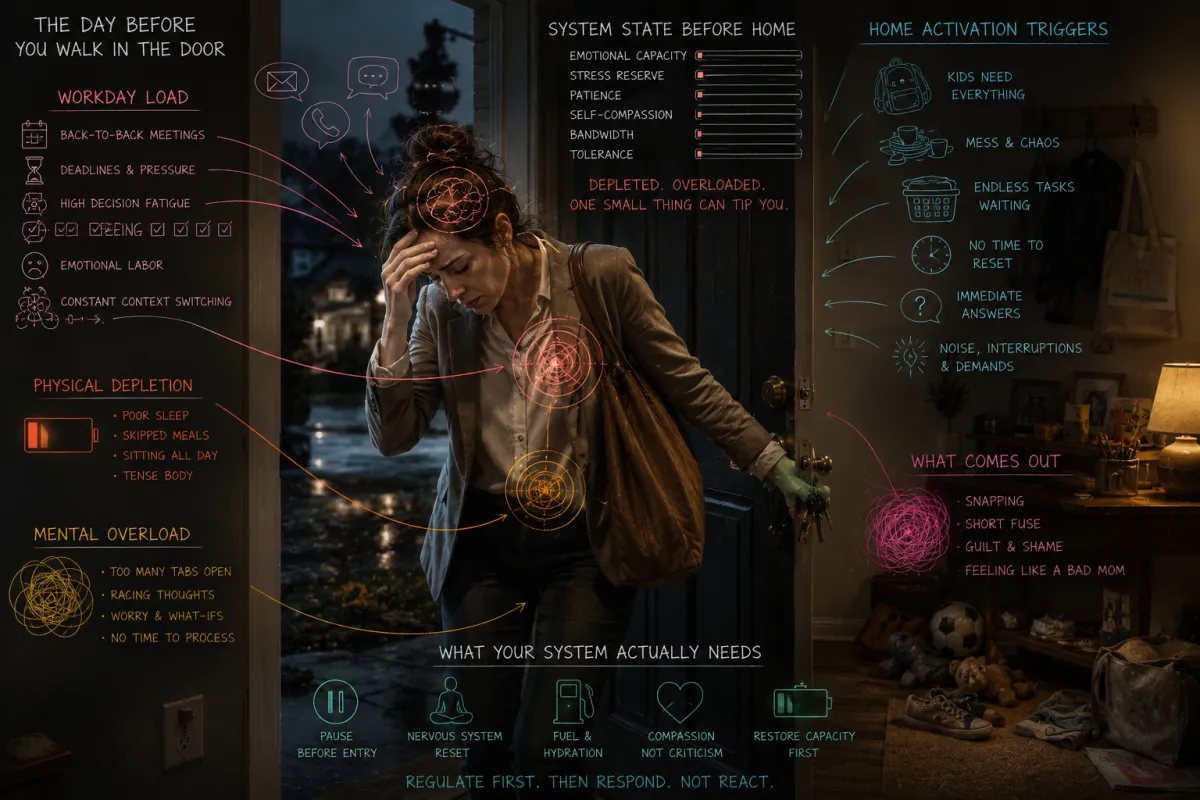
Something went wrong at work today. You stuffed it down because you had to. A colleague did not show up and you absorbed their load on top of your own. Then on the way home, a fender bender. Small, handled, added to the pile.
By the time your child's hand touched your arm, every single tank was past capacity.
The mental tank had been running decisions and problem-solving all day with no break. The social tank had been managing personalities, navigating tension, staying composed in rooms that required your best performance. The emotional tank had been absorbing everything that could not be shown at work — the frustration, the exhaustion, the things you had to swallow and keep moving.
And then your child's energy — their physical presence, their touch, their completely reasonable need for your attention — hit a system with nothing left to receive it.
The physical contact was the last straw even though you know your child didn't do anything wrong but your energetic and social tanks had been so full for so long that the overflow had nowhere left to go except into the physical.
Their touch triggered the release valve.
That is not a character flaw. That is a system that has been running past capacity all day with no place to put the pressure down.
Why the Shame Spiral Makes It Worse
Here is what happens after the snap.
You cannot stop thinking about it. The image of their face replays. You catalogue every word you said and how it landed. You tell yourself the story of what kind of parent that makes you.
And then — and this is the part worth looking at honestly — you try to fix it by making it up to them. You offer something. A treat, extra screen time, an apology wrapped in a gesture. Something that says I am sorry without requiring you to sit in the discomfort of full accountability.
That is not repair. That is a bribe for forgiveness. And underneath it is avoidance — of the shame, of the conversation, of the real work of owning what happened and showing your child what repair actually looks like.
The shame spiral keeps you focused on yourself. On how bad you feel. On what this says about you. And while you are spinning in that, your child is waiting for something more useful than your guilt.
The spiral does not protect your child. It just keeps you stuck.
Why It Bothers You This Much
Here is the piece most people miss.
The reason this particular wound — snapping at your kids — cuts so deep is not just because of the capacity overflow. It is because it conflicts directly with who you believe yourself to be.
You value being a good parent. Not as an aspiration. As a core part of your identity. It is connected to something foundational in your value system — protection, safety, being the person your child can trust. When the snap happens, it does not just feel like a bad moment. It feels like evidence that you are failing at something that matters more to you than almost anything else.
That is why the shame is so unbearable. It is not proportionate to the behavior. It is proportionate to the value it violated.
Understanding this does not excuse the behavior. But it changes what you do with the shame. Instead of using it to tear yourself down, you can use it as information. The intensity of how bad you feel is a direct signal of how much this matters to you. That is not a character flaw. That is a value expressing itself — badly, in the wrong direction, but still a signal of something real and worth honoring.
And when you start to see your child through the same lens — as a system with their own tanks, their own capacity, their own signals — the moment shifts from a moral failure into something you can actually work with. Two systems interacting under pressure. Both doing the best they can with what they have available.
That objectivity is not cold. It is the thing that makes genuine repair possible.
The Pattern Has a Rhythm
Here is the practical truth.
This is not random. The snap does not come out of nowhere. It follows a pattern — and that pattern is attached to what you value and what consistently fills your tanks before you get home.
The days it happens are not mystery days. They are the days your colleague does not show. The days a meeting runs long and you absorb someone else's problem. The days the drive home has friction. The days you have been performing all day without a single moment of actual decompression.
Your child is not the problem. They are the last stop on a route that was already full before they ever saw you.
Which means the intervention does not happen at the moment of the snap. It happens earlier. On the drive home.
That transition — the space between work and walking through the door — is one of the most underused resources a parent has. Not to add more to process. To put some of the day's load down before you bring it inside.
It can be music that shifts your state. A specific playlist you know moves something in you. It can be five minutes of silence before you park. It can be a route that gives you ten minutes longer. It can be a deliberate question you ask yourself: what is still in my tanks right now, and is any of it mine to carry through the front door tonight?
You cannot always control what fills the tanks during the day. You can build a ritual that creates a little space before you walk in.
That space is what your child actually needs from you. Not perfection. Presence. And presence requires room.
What to Take From This
You are not broken as a parent. You are a person running a complex system under significant daily load who has not yet built the bridge between understanding the pattern and interrupting it before it lands on someone you love.
The snap happens because the tanks are full. The shame is so intense because it violates something you deeply value. The spiral keeps you stuck because it keeps the focus on you instead of on repair.
Know why it matters to you. Watch for the pattern. Build the transition.
The drive home is not wasted time. It is the most important parenting move you can make.