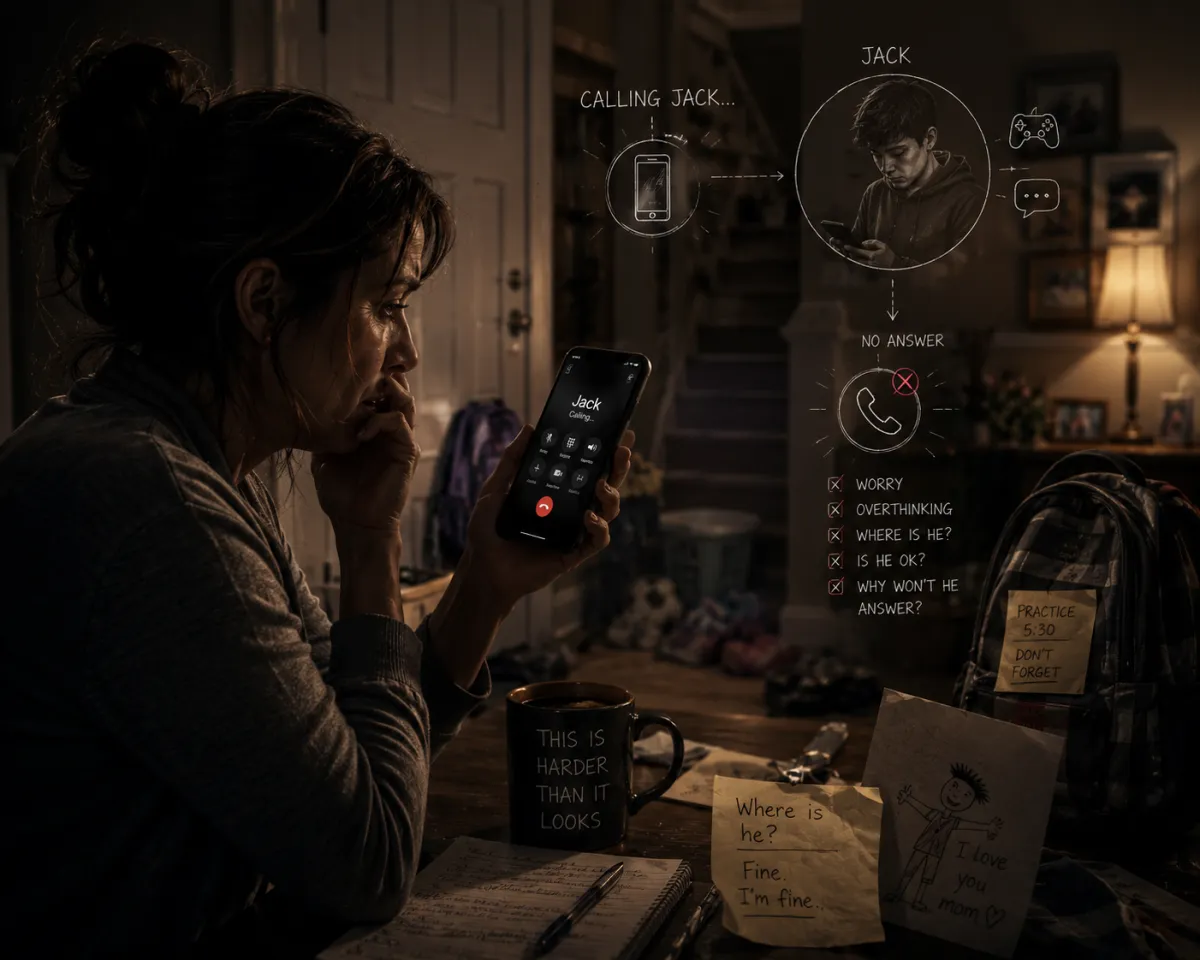
My Child Has Cut Me Off...What Did I Do Wrong?
That is the first question.
Every parent who arrives at this place asks it the same way. What did I do wrong? They go back through everything. Every decision, every conversation, every moment they can think of. They look through their own memory of what happened and they cannot find it. They did the best they could. They showed up. They provided. They loved their child the way they knew how to love them.
And their child still left.
So then it shifts to one of three places. I did everything right and I am not being appreciated. Or: I did the best I could and that should be enough. Or simply: this does not make sense to me.
All three of those responses have something in common. They are all looking through the same lens. The parent's lens. And that lens, no matter how honest or how loving, cannot show you what your child actually sees.
That is where most estrangement gets stuck. Not in who was right. In who can see past their own lens long enough to see another person.
What You Cannot See From Inside Your Own Lens
Your child is not a child anymore.
That sounds obvious. But in practice, in the way the relationship actually functions, most parents are still relating to their adult child through the framework of the relationship they had when that child was young. The roles, the expectations, the family constructs around what a parent is supposed to be and what a child is supposed to give back — those were built decades ago and most parents carry them forward without examining them.
Your daughter is supposed to call regularly. Your son is supposed to bring his family to holidays. Grandchildren are owed to grandparents regardless of what happened between the adults. These are not personal beliefs exactly. They are inherited constructs. Generational, cultural, sometimes religious. They feel like the way things simply are because they have been in place so long they became invisible.
Your adult child is striving for something different. Individuation. The right to be a separate person with their own values, their own choices, their own definition of what a family relationship looks like as an adult. When the parent's constructs and the child's individuation pull in opposite directions for long enough, the child eventually stops pulling and steps back entirely.
The estrangement is not random. It is the adult child's system refusing to continue in a dynamic that has no room for who they actually are.
There is also something happening in the broader culture worth naming honestly. The language of narcissism, gaslighting, and toxic parents has become a framework many adult children use to make sense of their experience. Sometimes that language is accurate. Often it is the closest vocabulary someone has found for a dynamic that is really about values misalignment, unmet emotional needs, and constructs that never got examined.
Diagnosing the relationship does not repair it. And a parent who responds to that language with defensiveness closes the door before it ever opens.
What Pushes the Child Further Away
When parents decide to act, the first move is usually to suggest therapy. Together, or for the child. The intention is good. The impact is often the opposite of what was intended — it signals to the child that something is wrong with them, that their feelings are a problem to be fixed rather than a signal to be heard.
The next move is often the inverse: the child suggests therapy and the parent refuses. Not always outright. Sometimes it is a deflection. Sometimes it is minimizing. But the message the child receives is that the parent is not willing to look at themselves. And that message lands exactly as you would expect it to.
But underneath both of those mistakes is the bigger one.
The parent is still trying to be the authority.
You are not the authority of an adult. You never were. The authority dynamic works when a child is young and genuinely needs guidance, structure, protection. Your adult child does not need that from you anymore. What they need — what any adult needs from a relationship — is to be seen as an equal. To be heard without being corrected. To have their experience received without being measured against your moral framework or your generational understanding of how things should be.
The parent who walks into a conversation with their adult child still holding the position of authority is not having a conversation. They are conducting an evaluation. And the child knows it. They have always known it. It is part of why they left.
What Changes When You Put the Lens Down
Here is what I see happen when a parent is finally willing to set aside the constructs — the roles, the expectations, the righteousness, the ideas of how this is supposed to go — and look at the actual human being in front of them.
They see their child for the first time in a long time.
Not the child they raised. Not the child they wanted. Not the child who was supposed to call more or come to holidays or raise their grandchildren in a particular way. The actual adult human being they brought into the world who has been trying to be seen clearly for years.
When that shift happens, something in the parent settles. The defensiveness drops. The need to be right about what happened loosens its grip. And in that space, curiosity becomes possible.
Curiosity is the thing almost every estranged parent I have worked with was missing. Not love — they had love. Not intention — most of them had good intentions. Curiosity. The genuine desire to know what lights their child up. What their child's experience of the world actually is. What the child has needed from this relationship that they never felt they received.
The parents who get their children back — or who rebuild something real and new — are not the ones who argued their case most effectively. They are the ones who finally got quiet enough to listen.
They open a door. Not with conditions. Not with a request to relitigate the past. With something simple: I have been doing some work on myself. I see some things I did not see before. If you are ever open to a different kind of conversation than we have had before, I would like to have it.
And then when the conversation happens, they do the thing that is hardest for any parent to do.
They shut up and listen.
They do not explain. They do not defend. They do not contextualize what the child is saying against their own memory of events. They listen. They say thank you for sharing that. And they mean it.
That is the door. It is not complicated. It is just the hardest thing most parents have ever done.
Your Lens Is Not the Only Lens
This is the thing worth sitting with after you finish reading this.
Your lens — the one built from your generation, your culture, your religion, your understanding of what a parent is and what a child owes — is not wrong exactly. It is yours. It is real. It shaped everything you did.
But it is not the only lens.
And if you cannot move it out of the way long enough to see through your child's lens, you will keep missing the picture. No matter how many times you go back through the memories. No matter how clearly you can see your own good intentions.
Good intentions seen only through your own lens are still invisible to the person on the other side.
When you let go of the belief structures, the ideas of right and wrong, the constructs of how this relationship is supposed to work — when all of that falls away — what is left is a human being. Your human being. One who has been waiting, in their own way, to be seen without all of it.
That is the beginning of something different.
Not a return to what was. Something better than what was. A relationship between two adults who actually know each other — not the roles they were assigned, but the people underneath them.
That relationship is possible. I have watched it happen. But it only starts when one person is willing to put their lens down first.
In most cases, that person has to be you.
If you are ready to understand what is actually happening in your family system — not whose fault it is, but what is driving the dynamic and what would have to shift for something new to become possible — that is exactly the work we do inside The YOUniverse. Come in. Do the 7-Day Capacity Reset. Start to see your own system clearly. That clarity is what makes the conversation with your child possible.